 |
JUCE v8.0.9
JUCE API
|

|
|
JUCE v8.0.9
JUCE API
|
|
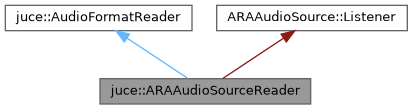
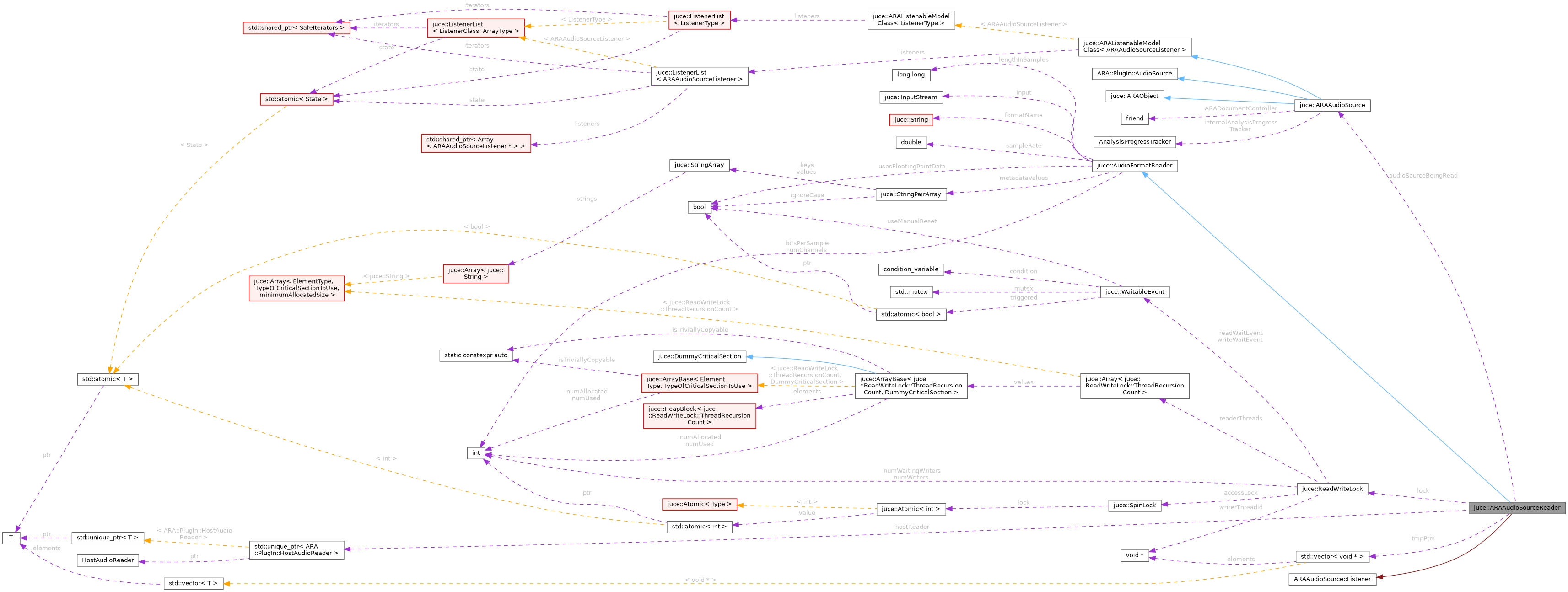
Subclass of AudioFormatReader that reads samples from a single ARA audio source. More...
#include <juce_ARAAudioReaders.h>
Public Member Functions | |
| ARAAudioSourceReader (ARAAudioSource *audioSource) | |
Use an ARAAudioSource to construct an audio source reader for the given audioSource. | |
| ~ARAAudioSourceReader () override | |
| void | didEnableAudioSourceSamplesAccess (ARAAudioSource *audioSource, bool enable) override |
| Called after access to an audio source's samples is enabled or disabled. | |
| void | doUpdateAudioSourceContent (ARAAudioSource *audioSource, ARAContentUpdateScopes scopeFlags) override |
| Called when the audio source's content (i.e. | |
| virtual AudioChannelSet | getChannelLayout () |
| Get the channel layout of the audio stream. | |
| const String & | getFormatName () const noexcept |
| Returns a description of what type of format this is. | |
| void | invalidate () |
| Invalidate the reader - the reader will call this internally if needed, but can also be invalidated from the outside (from message thread only!). | |
| bool | isValid () const |
| Returns true as long as the reader's underlying ARAAudioSource remains accessible and its sample content is not changed. | |
| bool | read (AudioBuffer< float > *buffer, int startSampleInDestBuffer, int numSamples, int64 readerStartSample, bool useReaderLeftChan, bool useReaderRightChan) |
| Fills a section of an AudioBuffer from this reader. | |
| bool | read (float *const *destChannels, int numDestChannels, int64 startSampleInSource, int numSamplesToRead) |
| Reads samples from the stream. | |
| bool | read (int *const *destChannels, int numDestChannels, int64 startSampleInSource, int numSamplesToRead, bool fillLeftoverChannelsWithCopies) |
| Reads samples from the stream. | |
| virtual void | readMaxLevels (int64 startSample, int64 numSamples, float &lowestLeft, float &highestLeft, float &lowestRight, float &highestRight) |
| Finds the highest and lowest sample levels from a section of the audio stream. | |
| virtual void | readMaxLevels (int64 startSample, int64 numSamples, Range< float > *results, int numChannelsToRead) |
| Finds the highest and lowest sample levels from a section of the audio stream. | |
| bool | readSamples (int *const *destSamples, int numDestChannels, int startOffsetInDestBuffer, int64 startSampleInFile, int numSamples) override |
| Subclasses must implement this method to perform the low-level read operation. | |
| int64 | searchForLevel (int64 startSample, int64 numSamplesToSearch, double magnitudeRangeMinimum, double magnitudeRangeMaximum, int minimumConsecutiveSamples) |
| Scans the source looking for a sample whose magnitude is in a specified range. | |
| void | willDestroyAudioSource (ARAAudioSource *audioSource) override |
| Called before the audio source is destroyed. | |
| void | willEnableAudioSourceSamplesAccess (ARAAudioSource *audioSource, bool enable) override |
| Called before access to an audio source's samples is enabled or disabled. | |
| void | willUpdateAudioSourceProperties (ARAAudioSource *audioSource, ARAAudioSource::PropertiesPtr newProperties) override |
| Called before the audio source's properties are updated. | |
Public Attributes | |
| unsigned int | bitsPerSample = 0 |
| The number of bits per sample, e.g. | |
| InputStream * | input |
| The input stream, for use by subclasses. | |
| int64 | lengthInSamples = 0 |
| The total number of samples in the audio stream. | |
| StringPairArray | metadataValues |
| A set of metadata values that the reader has pulled out of the stream. | |
| unsigned int | numChannels = 0 |
| The total number of channels in the audio stream. | |
| double | sampleRate = 0 |
| The sample-rate of the stream. | |
| bool | usesFloatingPointData = false |
| Indicates whether the data is floating-point or fixed. | |
Static Protected Member Functions | |
| static void | clearSamplesBeyondAvailableLength (int *const *destChannels, int numDestChannels, int startOffsetInDestBuffer, int64 startSampleInFile, int &numSamples, int64 fileLengthInSamples) |
| Used by AudioFormatReader subclasses to clear any parts of the data blocks that lie beyond the end of their available length. | |
Private Member Functions | |
| virtual void | didAddAudioModificationToAudioSource (ARAAudioSource *audioSource, ARAAudioModification *audioModification) |
| Called after an audio modification is added to the audio source. | |
| virtual void | didDeactivateAudioSourceForUndoHistory (ARAAudioSource *audioSource, bool deactivate) |
| Called after an audio source is activated or deactivated when being removed / added from the host's undo history. | |
| virtual void | didUpdateAudioSourceAnalysisProgress (ARAAudioSource *audioSource, ARA::ARAAnalysisProgressState state, float progress) |
| Called to notify progress when an audio source is being analyzed. | |
| virtual void | didUpdateAudioSourceProperties (ARAAudioSource *audioSource) |
| Called after the audio source's properties are updated. | |
| virtual void | willDeactivateAudioSourceForUndoHistory (ARAAudioSource *audioSource, bool deactivate) |
| Called before an audio source is activated or deactivated when being removed / added from the host's undo history. | |
| virtual void | willRemoveAudioModificationFromAudioSource (ARAAudioSource *audioSource, ARAAudioModification *audioModification) |
| Called before an audio modification is removed from the audio source. | |
Private Attributes | |
| ARAAudioSource * | audioSourceBeingRead |
| String | formatName |
| std::unique_ptr< ARA::PlugIn::HostAudioReader > | hostReader |
| ReadWriteLock | lock |
| std::vector< void * > | tmpPtrs |
Subclass of AudioFormatReader that reads samples from a single ARA audio source.
Plug-Ins typically use this from their rendering code, wrapped in a BufferingAudioReader to bridge between realtime rendering and non-realtime audio reading.
The reader becomes invalidated if
@tags{ARA}
|
explicit |
Use an ARAAudioSource to construct an audio source reader for the given audioSource.
|
override |
|
inlinestaticprotectedinherited |
Used by AudioFormatReader subclasses to clear any parts of the data blocks that lie beyond the end of their available length.
References jassertfalse, and juce::zeromem().
|
virtualinherited |
Called after an audio modification is added to the audio source.
| audioSource | The region sequence that audioModification was added to. |
| audioModification | The playback region that was added to audioSource. |
|
virtualinherited |
Called after an audio source is activated or deactivated when being removed / added from the host's undo history.
| audioSource | The audio source that was activated or deactivated |
| deactivate | A bool indicating whether audioSource was deactivated or activated. |
|
overridevirtual |
Called after access to an audio source's samples is enabled or disabled.
| audioSource | The audio source whose sample access state was changed. |
| enable | A bool indicating whether or not sample access was enabled or disabled. |
Reimplemented from juce::ARAAudioSourceListener.
|
virtualinherited |
Called to notify progress when an audio source is being analyzed.
| audioSource | The audio source being analyzed. |
| state | Indicates start, intermediate update or completion of the analysis. |
| progress | Progress normalized to the 0..1 range. |
|
virtualinherited |
Called after the audio source's properties are updated.
| audioSource | The audio source whose properties were updated. |
|
overridevirtual |
Called when the audio source's content (i.e.
samples or notes) changes.
| audioSource | The audio source with updated content. |
| scopeFlags | The scope of the content update. |
Reimplemented from juce::ARAAudioSourceListener.
|
virtualinherited |
Get the channel layout of the audio stream.
|
inlinenoexceptinherited |
Returns a description of what type of format this is.
E.g. "AIFF"
| void juce::ARAAudioSourceReader::invalidate | ( | ) |
Invalidate the reader - the reader will call this internally if needed, but can also be invalidated from the outside (from message thread only!).
|
inline |
Returns true as long as the reader's underlying ARAAudioSource remains accessible and its sample content is not changed.
|
inherited |
Fills a section of an AudioBuffer from this reader.
This will convert the reader's fixed- or floating-point data to the buffer's floating-point format, and will try to intelligently cope with mismatches between the number of channels in the reader and the buffer.
|
inherited |
Reads samples from the stream.
| destChannels | an array of float buffers into which the sample data for each channel will be written. Channels that aren't needed can be null |
| numDestChannels | the number of array elements in the destChannels array |
| startSampleInSource | the position in the audio file or stream at which the samples should be read, as a number of samples from the start of the stream. It's ok for this to be beyond the start or end of the available data - any samples that are out-of-range will be returned as zeros. |
| numSamplesToRead | the number of samples to read. If this is greater than the number of samples that the file or stream contains. the result will be padded with zeros |
|
inherited |
Reads samples from the stream.
| destChannels | an array of buffers into which the sample data for each channel will be written. If the format is fixed-point, each channel will be written as an array of 32-bit signed integers using the full range -0x80000000 to 0x7fffffff, regardless of the source's bit-depth. If it is a floating-point format, you should cast the resulting array to a (float**) to get the values (in the range -1.0 to 1.0 or beyond) If the format is stereo, then destChannels[0] is the left channel data, and destChannels[1] is the right channel. The numDestChannels parameter indicates how many pointers this array contains, but some of these pointers can be null if you don't want to read data for some of the channels |
| numDestChannels | the number of array elements in the destChannels array |
| startSampleInSource | the position in the audio file or stream at which the samples should be read, as a number of samples from the start of the stream. It's ok for this to be beyond the start or end of the available data - any samples that are out-of-range will be returned as zeros. |
| numSamplesToRead | the number of samples to read. If this is greater than the number of samples that the file or stream contains. the result will be padded with zeros |
| fillLeftoverChannelsWithCopies | if true, this indicates that if there's no source data available for some of the channels that you pass in, then they should be filled with copies of valid source channels. E.g. if you're reading a mono file and you pass 2 channels to this method, then if fillLeftoverChannelsWithCopies is true, both destination channels will be filled with the same data from the file's single channel. If fillLeftoverChannelsWithCopies was false, then only the first channel would be filled with the file's contents, and the second would be cleared. If there are many channels, e.g. you try to read 4 channels from a stereo file, then the last 3 would all end up with copies of the same data. |
|
virtualinherited |
Finds the highest and lowest sample levels from a section of the audio stream.
This will read a block of samples from the stream, and measure the highest and lowest sample levels from the channels in that section, returning these as normalised floating-point levels.
| startSample | the offset into the audio stream to start reading from. It's ok for this to be beyond the start or end of the stream. |
| numSamples | how many samples to read |
| lowestLeft | on return, this is the lowest absolute sample from the left channel |
| highestLeft | on return, this is the highest absolute sample from the left channel |
| lowestRight | on return, this is the lowest absolute sample from the right channel (if there is one) |
| highestRight | on return, this is the highest absolute sample from the right channel (if there is one) |
Reimplemented in juce::AudioSubsectionReader.
|
virtualinherited |
Finds the highest and lowest sample levels from a section of the audio stream.
This will read a block of samples from the stream, and measure the highest and lowest sample levels from the channels in that section, returning these as normalised floating-point levels.
| startSample | the offset into the audio stream to start reading from. It's ok for this to be beyond the start or end of the stream. |
| numSamples | how many samples to read |
| results | this array will be filled with Range values for each channel. The array must contain numChannels elements. |
| numChannelsToRead | the number of channels of data to scan. This must be more than zero, but not more than the total number of channels that the reader contains |
Reimplemented in juce::AudioSubsectionReader, and juce::AudioSubsectionReader.
|
overridevirtual |
Subclasses must implement this method to perform the low-level read operation.
Callers should use read() instead of calling this directly.
| destChannels | the array of destination buffers to fill. Some of these pointers may be null |
| numDestChannels | the number of items in the destChannels array. This value is guaranteed not to be greater than the number of channels that this reader object contains |
| startOffsetInDestBuffer | the number of samples from the start of the dest data at which to begin writing |
| startSampleInFile | the number of samples into the source data at which to begin reading. This value is guaranteed to be >= 0. |
| numSamples | the number of samples to read |
Implements juce::AudioFormatReader.
|
inherited |
Scans the source looking for a sample whose magnitude is in a specified range.
This will read from the source, either forwards or backwards between two sample positions, until it finds a sample whose magnitude lies between two specified levels.
If it finds a suitable sample, it returns its position; if not, it will return -1.
There's also a minimumConsecutiveSamples setting to help avoid spikes or zero-crossing points when you're searching for a continuous range of samples
| startSample | the first sample to look at |
| numSamplesToSearch | the number of samples to scan. If this value is negative, the search will go backwards |
| magnitudeRangeMinimum | the lowest magnitude (inclusive) that is considered a hit, from 0 to 1.0 |
| magnitudeRangeMaximum | the highest magnitude (inclusive) that is considered a hit, from 0 to 1.0 |
| minimumConsecutiveSamples | if this is > 0, the method will only look for a sequence of this many consecutive samples, all of which lie within the target range. When it finds such a sequence, it returns the position of the first in-range sample it found (i.e. the earliest one if scanning forwards, the latest one if scanning backwards) |
|
virtualinherited |
Called before an audio source is activated or deactivated when being removed / added from the host's undo history.
| audioSource | The audio source that will be activated or deactivated |
| deactivate | A bool indicating whether audioSource was deactivated or activated. |
|
overridevirtual |
Called before the audio source is destroyed.
| audioSource | The audio source that will be destroyed. |
Reimplemented from juce::ARAAudioSourceListener.
|
overridevirtual |
Called before access to an audio source's samples is enabled or disabled.
| audioSource | The audio source whose sample access state will be changed. |
| enable | A bool indicating whether or not sample access will be enabled or disabled. |
Reimplemented from juce::ARAAudioSourceListener.
|
virtualinherited |
Called before an audio modification is removed from the audio source.
| audioSource | The audio source that audioModification will be removed from. |
| audioModification | The audio modification that will be removed from audioSource. |
|
overridevirtual |
Called before the audio source's properties are updated.
| audioSource | The audio source whose properties will be updated. |
| newProperties | The audio source properties that will be assigned to audioSource. |
Reimplemented from juce::ARAAudioSourceListener.
|
private |
|
inherited |
The number of bits per sample, e.g.
16, 24, 32.
|
privateinherited |
|
private |
|
inherited |
The input stream, for use by subclasses.
|
inherited |
The total number of samples in the audio stream.
|
private |
|
inherited |
A set of metadata values that the reader has pulled out of the stream.
Exactly what these values are depends on the format, so you can check out the format implementation code to see what kind of stuff they understand.
|
inherited |
The total number of channels in the audio stream.
|
inherited |
The sample-rate of the stream.
|
private |
|
inherited |
Indicates whether the data is floating-point or fixed.
 1.9.8
1.9.8