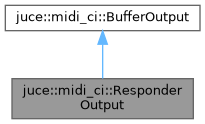
A buffer output that additionally provides information about an incoming message, so that an appropriate reply can be constructed for that message.
More...
#include <juce_CIResponderOutput.h>
A buffer output that additionally provides information about an incoming message, so that an appropriate reply can be constructed for that message.
@tags{Audio}
◆ getChannelAddress()
| ChannelAddress juce::midi_ci::ResponderOutput::getChannelAddress |
( |
| ) |
const |
Returns the channel to which the incoming message was addressed.
◆ getIncomingGroup()
| virtual uint8_t juce::midi_ci::ResponderOutput::getIncomingGroup |
( |
| ) |
const |
|
pure virtual |
Returns the group of the message that was received.
◆ getIncomingHeader()
| virtual Message::Header juce::midi_ci::ResponderOutput::getIncomingHeader |
( |
| ) |
const |
|
pure virtual |
Returns the header of the message that was received.
◆ getMuid()
| virtual MUID juce::midi_ci::BufferOutput::getMuid |
( |
| ) |
const |
|
pure virtualinherited |
Returns the MUID of the responder.
◆ getOutputBuffer()
| virtual std::vector< std::byte > & juce::midi_ci::BufferOutput::getOutputBuffer |
( |
| ) |
|
|
pure virtualinherited |
Returns the buffer into which replies should be written.
◆ getReplyHeader()
| Message::Header juce::midi_ci::ResponderOutput::getReplyHeader |
( |
std::byte |
replySubID | ) |
const |
Returns a default header that can be used for outgoing replies.
This always sets the destination MUID equal to the source MUID of the incoming header, so it's not suitable for broadcast messages.
◆ send()
| virtual void juce::midi_ci::BufferOutput::send |
( |
uint8_t |
group | ) |
|
|
pure virtualinherited |
Sends the current contents of the buffer to the provided group.
The documentation for this class was generated from the following file:


 1.9.8
1.9.8