 |
JUCE v8.0.9
JUCE API
|

|
|
JUCE v8.0.9
JUCE API
|
|
Represents a particular font, including its size, style, etc. More...
#include <juce_Font.h>
Public Types | |
| enum | FontStyleFlags { plain = 0 , bold = 1 , italic = 2 , underlined = 4 } |
| A combination of these values is used by the constructor to specify the style of font to use. More... | |
Public Member Functions | |
| Font () | |
| Creates a basic sans-serif font at a default height. | |
| Font (const Font &other) noexcept | |
| Creates a copy of another Font object. | |
| Font (const String &typefaceName, const String &typefaceStyle, float fontHeight) | |
| Creates a font with a given typeface and parameters. | |
| Font (const String &typefaceName, float fontHeight, int styleFlags) | |
| Creates a font with a given typeface and parameters. | |
| Font (const Typeface::Ptr &typeface) | |
| Creates a font for a typeface. | |
| Font (float fontHeight, int styleFlags=plain) | |
| Creates a sans-serif font in a given size. | |
| Font (Font &&other) noexcept | |
| Move constructor. | |
| Font (FontOptions options) | |
| Constructs a Font from a set of options describing the font. | |
| ~Font () noexcept | |
| Destructor. | |
| Font | boldened () const |
| Returns a copy of this font with the bold attribute set. | |
| Font | findSuitableFontForText (const String &text, const String &language={}) const |
| Attempts to locate a visually similar font that is capable of rendering the provided string. | |
| float | getAscent () const |
| Returns the height of the font above its baseline, in pixels. | |
| float | getAscentInPoints () const |
| Returns the height of the font above its baseline, in points. | |
| std::optional< float > | getAscentOverride () const noexcept |
| StringArray | getAvailableStyles () const |
| Returns a list of the styles that this font can use. | |
| float | getDescent () const |
| Returns the amount that the font descends below its baseline, in pixels. | |
| float | getDescentInPoints () const |
| Returns the amount that the font descends below its baseline, in points. | |
| std::optional< float > | getDescentOverride () const noexcept |
| float | getExtraKerningFactor () const noexcept |
| Returns the font's tracking, i.e. | |
| bool | getFallbackEnabled () const |
| Returns true if fallback is enabled, or false otherwise. | |
| Span< const FontFeatureSetting > | getFeatureSettings () const & |
| Returns an Span view of the features configured for this font instance. | |
| Span< const FontFeatureSetting > | getFeatureSettings () const &&=delete |
| float | getHeight () const noexcept |
| Returns the total height of this font, in pixels. | |
| float | getHeightInPoints () const |
| Returns the total height of this font, in points. | |
| float | getHorizontalScale () const noexcept |
| Returns the font's horizontal scale. | |
| TypefaceMetricsKind | getMetricsKind () const noexcept |
| Returns the kind of metrics used by this Font. | |
| Native | getNativeDetails () const |
| StringArray | getPreferredFallbackFamilies () const |
| Returns the names of the fallback font families. | |
| int | getStringWidth (const String &text) const |
| Returns the total width of a string as it would be drawn using this font. | |
| float | getStringWidthFloat (const String &text) const |
| Returns the total width of a string as it would be drawn using this font. | |
| int | getStyleFlags () const noexcept |
| Returns the font's style flags. | |
| String | getTypefaceName () const noexcept |
| Returns the font family of the typeface that this font uses. | |
| Typeface::Ptr | getTypefacePtr () const |
| Returns the main typeface used by this font. | |
| String | getTypefaceStyle () const noexcept |
| Returns the font style of the typeface that this font uses. | |
| bool | isBold () const noexcept |
| Returns true if the font is bold. | |
| bool | isItalic () const noexcept |
| Returns true if the font is italic. | |
| bool | isUnderlined () const noexcept |
| Returns true if the font is underlined. | |
| Font | italicised () const |
| Returns a copy of this font with the italic attribute set. | |
| bool | operator!= (const Font &other) const noexcept |
| Font & | operator= (const Font &other) noexcept |
| Copies this font from another one. | |
| Font & | operator= (Font &&other) noexcept |
| Move assignment operator. | |
| bool | operator== (const Font &other) const noexcept |
| void | removeFeatureSetting (FontFeatureTag featureToRemove) |
| Removes a specific feature setting from this font. | |
| void | setAscentOverride (std::optional< float >) |
| This is designed to mirror CSS's ascent-override property. | |
| void | setBold (bool shouldBeBold) |
| Makes the font bold or non-bold. | |
| void | setDescentOverride (std::optional< float >) |
| This is designed to mirror CSS's descent-override property. | |
| void | setExtraKerningFactor (float extraKerning) |
| Changes the font's tracking. | |
| void | setFallbackEnabled (bool enabled) |
| When drawing text using this Font, specifies whether glyphs that are missing in the main typeface should be replaced with glyphs from other fonts. | |
| void | setFeatureSetting (FontFeatureSetting featureSetting) |
| Enables or disables a font feature. | |
| void | setHeight (float newHeight) |
| Changes the font's height. | |
| void | setHeightWithoutChangingWidth (float newHeight) |
| Changes the font's height without changing its width. | |
| void | setHorizontalScale (float scaleFactor) |
| Changes the font's horizontal scale factor. | |
| void | setItalic (bool shouldBeItalic) |
| Makes the font italic or non-italic. | |
| void | setPointHeight (float newHeight) |
| Changes the font's height. | |
| void | setPreferredFallbackFamilies (const StringArray &fallbacks) |
| Sets the names of the fallback font families that should be tried, in order, when searching for glyphs that are missing in the main typeface, specified via setTypefaceName() or Font(const Typeface::Ptr&). | |
| void | setSizeAndStyle (float newHeight, const String &newStyle, float newHorizontalScale, float newKerningAmount) |
| Changes all the font's characteristics with one call. | |
| void | setSizeAndStyle (float newHeight, int newStyleFlags, float newHorizontalScale, float newKerningAmount) |
| Changes all the font's characteristics with one call. | |
| void | setStyleFlags (int newFlags) |
| Changes the font's style. | |
| void | setTypefaceName (const String &faceName) |
| Changes the font family of the typeface. | |
| void | setTypefaceStyle (const String &newStyle) |
| Changes the font style of the typeface. | |
| void | setUnderline (bool shouldBeUnderlined) |
| Makes the font underlined or non-underlined. | |
| String | toString () const |
| Creates a string to describe this font. | |
| Font | withExtraKerningFactor (float extraKerning) const |
| Returns a copy of this font with a new tracking factor. | |
| Font | withHeight (float height) const |
| Returns a copy of this font with a new height. | |
| Font | withHorizontalScale (float scaleFactor) const |
| Returns a copy of this font with a new horizontal scale. | |
| Font | withPointHeight (float heightInPoints) const |
| Returns a copy of this font with a new height, specified in points. | |
| Font | withStyle (int styleFlags) const |
| Returns a copy of this font with the given set of style flags. | |
| Font | withTypefaceStyle (const String &newStyle) const |
| Returns a copy of this font with a new typeface style. | |
Static Public Member Functions | |
| static StringArray | findAllTypefaceNames () |
| Returns a list of all the available typeface font families. | |
| static StringArray | findAllTypefaceStyles (const String &family) |
| Returns a list of all the available typeface font styles. | |
| static void | findFonts (Array< Font > &results) |
| Creates an array of Font objects to represent all the fonts on the system. | |
| static Font | fromString (const String &fontDescription) |
| Recreates a font from its stringified encoding. | |
| static float | getDefaultMinimumHorizontalScaleFactor () noexcept |
| Returns the minimum horizontal scale to which fonts may be squashed when trying to create a layout. | |
| static const String & | getDefaultMonospacedFontName () |
| Returns a typeface font family that represents the default monospaced font. | |
| static const String & | getDefaultSansSerifFontName () |
| Returns a typeface font family that represents the default sans-serif font. | |
| static const String & | getDefaultSerifFontName () |
| Returns a typeface font family that represents the default serif font. | |
| static const String & | getDefaultStyle () |
| Returns a font style name that represents the default style. | |
| static Typeface::Ptr | getDefaultTypefaceForFont (const Font &font) |
| Returns the default system typeface for the given font. | |
| static const String & | getSystemUIFontName () |
| Returns a typeface font family that represents the system UI font. | |
| static void | setDefaultMinimumHorizontalScaleFactor (float newMinimumScaleFactor) noexcept |
| Sets the minimum horizontal scale to which fonts may be squashed when trying to create a text layout. | |
Private Member Functions | |
| void | dupeInternalIfShared () |
| float | getHeightToPointsFactor () const |
Static Private Member Functions | |
| static bool | compare (const Font &, const Font &) noexcept |
Private Attributes | |
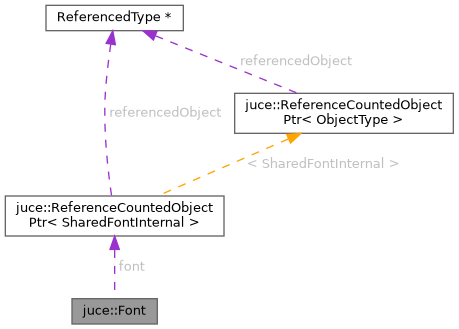
| ReferenceCountedObjectPtr< SharedFontInternal > | font |
Friends | |
| struct | GraphicsFontHelpers |
Represents a particular font, including its size, style, etc.
Apart from the typeface to be used, a Font object also dictates whether the font is bold, italic, underlined, how big it is, and its kerning and horizontal scale factor.
@tags{Graphics}
A combination of these values is used by the constructor to specify the style of font to use.
| Enumerator | |
|---|---|
| plain | indicates a plain, non-bold, non-italic version of the font.
|
| bold | boldens the font.
|
| italic | finds an italic version of the font.
|
| underlined | underlines the font.
|
| juce::Font::Font | ( | FontOptions | options | ) |
Constructs a Font from a set of options describing the font.
Creates a sans-serif font in a given size.
| fontHeight | the height in pixels (can be fractional) |
| styleFlags | the style to use - this can be a combination of the Font::bold, Font::italic and Font::underlined, or just Font::plain for the normal style. |
Creates a font with a given typeface and parameters.
| typefaceName | the font family of the typeface to use |
| fontHeight | the height in pixels (can be fractional) |
| styleFlags | the style to use - this can be a combination of the Font::bold, Font::italic and Font::underlined, or just Font::plain for the normal style. |
Creates a font with a given typeface and parameters.
| typefaceName | the font family of the typeface to use |
| typefaceStyle | the font style of the typeface to use |
| fontHeight | the height in pixels (can be fractional) |
| juce::Font::Font | ( | const Typeface::Ptr & | typeface | ) |
Creates a font for a typeface.
| juce::Font::Font | ( | ) |
Creates a basic sans-serif font at a default height.
You should use one of the other constructors for creating a font that you're planning on drawing with - this constructor is here to help initialise objects before changing the font's settings later.
|
noexcept |
Move constructor.
|
noexcept |
Destructor.
| Font juce::Font::boldened | ( | ) | const |
Returns a copy of this font with the bold attribute set.
If the font does not have a bold version, this will return the default font.
Referenced by juce::GraphicsFontHelpers::compareFont().
|
private |
|
static |
Returns a list of all the available typeface font families.
The names returned can be passed into setTypefaceName().
You can use this instead of findFonts() if you only need their font family names, and not font objects.
|
static |
Returns a list of all the available typeface font styles.
The names returned can be passed into setTypefaceStyle().
You can use this instead of findFonts() if you only need their styles, and not font objects.
Creates an array of Font objects to represent all the fonts on the system.
If you just need the font family names of the typefaces, you can also use findAllTypefaceNames() instead.
| results | the array to which new Font objects will be added. |
| Font juce::Font::findSuitableFontForText | ( | const String & | text, |
| const String & | language = {} |
||
| ) | const |
Attempts to locate a visually similar font that is capable of rendering the provided string.
If fallback is disabled on this Font by setFallbackEnabled(), then this will always return a copy of the current Font.
Otherwise, the current font, then each of the fallback fonts specified by setPreferredFallbackFamilies() will be checked, and the first Font that is capable of rendering the string will be returned. If none of these fonts is suitable, then the system font fallback mechanism will be used to locate a font from the currently installed fonts. If the system also cannot find any suitable font, then a copy of the original Font will be returned.
Note that most fonts don't contain glyphs for all possible unicode codepoints, and instead may contain e.g. just the glyphs required for a specific script. So, if the provided text would be displayed using several scripts (multiple languages, emoji, etc.) then there's a good chance that no single font will be able to render the entire text. Shorter strings will generally produce better fallback results than longer strings, with the caveat that the system may take control characters such as combining marks and variation selectors into account when selecting suitable fonts, so querying fallbacks character-by-character is likely to produce poor results.
Recreates a font from its stringified encoding.
This method takes a string that was created by toString(), and recreates the original font.
| float juce::Font::getAscent | ( | ) | const |
Returns the height of the font above its baseline, in pixels.
This is the maximum height from the baseline to the top.
| float juce::Font::getAscentInPoints | ( | ) | const |
Returns the height of the font above its baseline, in points.
This is the maximum height from the baseline to the top.
This value is affected by the optional ascent override.
|
noexcept |
| StringArray juce::Font::getAvailableStyles | ( | ) | const |
Returns a list of the styles that this font can use.
|
staticnoexcept |
Returns the minimum horizontal scale to which fonts may be squashed when trying to create a layout.
|
static |
Returns a typeface font family that represents the default monospaced font.
Note that this method just returns a generic placeholder string that means "the default monospaced font" - it's not the actual font family of this font.
|
static |
Returns a typeface font family that represents the default sans-serif font.
This is also the typeface that will be used when a font is created without specifying any typeface details.
Note that this method just returns a generic placeholder string that means "the default sans-serif font" - it's not the actual font family of this font.
|
static |
Returns a typeface font family that represents the default serif font.
Note that this method just returns a generic placeholder string that means "the default serif font" - it's not the actual font family of this font.
|
static |
Returns a font style name that represents the default style.
Note that this method just returns a generic placeholder string that means "the default font style" - it's not the actual name of the font style of any particular font.
|
static |
Returns the default system typeface for the given font.
Note: This will only ever return the typeface for the font's "main" family. Before attempting to render glyphs from this typeface, it's a good idea to check that those glyphs are present in the typeface, and to select a different face if necessary.
| float juce::Font::getDescent | ( | ) | const |
Returns the amount that the font descends below its baseline, in pixels.
This is calculated as (getHeight() - getAscent()).
| float juce::Font::getDescentInPoints | ( | ) | const |
Returns the amount that the font descends below its baseline, in points.
This is calculated as (getHeight() - getAscent()).
This value is affected by the optional descent override.
|
noexcept |
|
noexcept |
Returns the font's tracking, i.e.
spacing applied between characters in addition to the kerning defined by the font.
This is the extra space added between adjacent characters, as a proportion of the font's height.
A value of zero is normal spacing, positive values will spread the letters out more, and negative values make them closer together.
| bool juce::Font::getFallbackEnabled | ( | ) | const |
Returns true if fallback is enabled, or false otherwise.
| Span< const FontFeatureSetting > juce::Font::getFeatureSettings | ( | ) | const & |
Returns an Span view of the features configured for this font instance.
Use Typeface::getSupportedFeatures() to determine what features this font supports.
|
delete |
|
noexcept |
Returns the total height of this font, in pixels.
This is the maximum height, from the top of the ascent to the bottom of the descenders.
| float juce::Font::getHeightInPoints | ( | ) | const |
Returns the total height of this font, in points.
This is the maximum height, from the top of the ascent to the bottom of the descenders.
This value is not affected by the optional ascent or descent override.
|
private |
|
noexcept |
Returns the font's horizontal scale.
A value of 1.0 is the normal scale, less than this will be narrower, greater than 1.0 will be stretched out.
|
noexcept |
Returns the kind of metrics used by this Font.
| Native juce::Font::getNativeDetails | ( | ) | const |
At the moment, this is a way to get at the hb_font_t that backs this font. The typeface's hb_font_t is sized appropriately for this font instance. The font may also have synthetic slant and bold applied. This is only for internal use!
| StringArray juce::Font::getPreferredFallbackFamilies | ( | ) | const |
Returns the names of the fallback font families.
| int juce::Font::getStringWidth | ( | const String & | text | ) | const |
Returns the total width of a string as it would be drawn using this font.
For a more accurate floating-point result, use getStringWidthFloat().
This function does not take font fallback into account. If this font doesn't include glyphs to represent all characters in the string, then the width will be computed as though those characters were replaced with the "glyph not found" character.
If you are trying to find the amount of space required to display a given string, you'll get more accurate results by actually measuring the results of whichever text layout engine (e.g. GlyphArrangement, TextLayout) you'll use when displaying the string.
Returns the total width of a string as it would be drawn using this font.
This function does not take font fallback into account. If this font doesn't include glyphs to represent all characters in the string, then the width will be computed as though those characters were replaced with the "glyph not found" character.
If you are trying to find the amount of space required to display a given string, you'll get more accurate results by actually measuring the results of whichever text layout engine (e.g. GlyphArrangement, TextLayout) you'll use when displaying the string.
|
noexcept |
Returns the font's style flags.
This will return a bitwise-or'ed combination of values from the FontStyleFlags enum, to describe whether the font is bold, italic, etc.
|
static |
Returns a typeface font family that represents the system UI font.
Note that this method just returns a generic placeholder string that means "the default UI font" - it's not the actual font family of this font.
|
noexcept |
Returns the font family of the typeface that this font uses.
e.g. "Arial", "Courier", etc.
This may also be set to Font::getDefaultSansSerifFontName(), Font::getDefaultSerifFontName(), or Font::getDefaultMonospacedFontName(), which are not actual platform-specific font family names, but are generic font family names that are used to represent the various default fonts.
If you need to know the exact typeface font family being used, you can call Font::getTypefacePtr()->getName(), which will give you the platform-specific font family.
| Typeface::Ptr juce::Font::getTypefacePtr | ( | ) | const |
Returns the main typeface used by this font.
Note: This will only ever return the typeface for the "main" family. Before attempting to render glyphs from this typeface, it's a good idea to check that those glyphs are present in the typeface, and to select a different face if necessary.
|
noexcept |
Returns the font style of the typeface that this font uses.
|
noexcept |
Returns true if the font is bold.
|
noexcept |
Returns true if the font is italic.
|
noexcept |
Returns true if the font is underlined.
| Font juce::Font::italicised | ( | ) | const |
Returns a copy of this font with the italic attribute set.
| void juce::Font::removeFeatureSetting | ( | FontFeatureTag | featureToRemove | ) |
Removes a specific feature setting from this font.
If featureToRemove corresponds to a feature that is typically enabled by default (e.g., "calt" for contextual alternates, "liga" for standard ligatures), calling this method will reset it to its default-enabled state.
| void juce::Font::setAscentOverride | ( | std::optional< float > | ) |
This is designed to mirror CSS's ascent-override property.
When the font size is specified in points (using setPointHeight(), FontOptions::withPointHeight(), etc.), then the font's ascent value in points will be equal to the font's size in points multiplied by the override value. That is, if the font size is 14pt and the ascent override is 0.5f, then the ascent will be 7pt.
When the font size is not specified in points (using setHeight(), FontOptions::withHeight(), etc.), then the behaviour is more subtle. The ascent override still specifies the size of the font's ascender as a proportion of the font's em size. However, the point size of the font is now found by multiplying the JUCE height by the height-to-point factor, where this factor is equal to (1.0f / (ascent-in-em-units + descent-in-em-units)). As an example, if the JUCE font height is 14, the ascent override is 0.5f, and the descent override is 0.5f, then the font size will be 14pt and the ascent will be 7pt. Changing the ascent override to 1.0f and the descent override to 0.0f will preserve the font size of 14pt but give an ascender of 14pt and a descender of 0pt. Changing the ascent and descent overrides both to 1.0f will result in the font's size changing to 7pt with an ascent of 3.5pt.
| void juce::Font::setBold | ( | bool | shouldBeBold | ) |
Makes the font bold or non-bold.
|
staticnoexcept |
Sets the minimum horizontal scale to which fonts may be squashed when trying to create a text layout.
| void juce::Font::setDescentOverride | ( | std::optional< float > | ) |
This is designed to mirror CSS's descent-override property.
Specifies a value to replace the built-in typeface descent metric. The final descent value will be found by multiplying the provided value by the font size. You may also pass std::nullopt to use the descent value specified in the typeface.
The documentation for setAscentOverride() includes a more thorough discussion of the mechanism used for overriding.
| void juce::Font::setExtraKerningFactor | ( | float | extraKerning | ) |
Changes the font's tracking.
| extraKerning | a multiple of the font's height that will be added to space between the characters. So a value of zero is normal spacing, positive values spread the letters out, negative values make them closer together. |
| void juce::Font::setFallbackEnabled | ( | bool | enabled | ) |
When drawing text using this Font, specifies whether glyphs that are missing in the main typeface should be replaced with glyphs from other fonts.
To find missing glyphs, the typefaces for the preferred fallback families will be checked in order, followed by the system fallback fonts. The system fallback font is likely to be different on each platform.
Fallback is enabled by default.
| void juce::Font::setFeatureSetting | ( | FontFeatureSetting | featureSetting | ) |
Enables or disables a font feature.
Use Typeface::getSupportedFeatures() to determine what features this font supports.
| void juce::Font::setHeight | ( | float | newHeight | ) |
Changes the font's height.
The font will be scaled so that the sum of the ascender and descender is equal to the provided height in logical pixels.
| void juce::Font::setHeightWithoutChangingWidth | ( | float | newHeight | ) |
Changes the font's height without changing its width.
This alters the horizontal scale to compensate for the change in height.
| void juce::Font::setHorizontalScale | ( | float | scaleFactor | ) |
Changes the font's horizontal scale factor.
| scaleFactor | a value of 1.0 is the normal scale, less than this will be narrower, greater than 1.0 will be stretched out. |
| void juce::Font::setItalic | ( | bool | shouldBeItalic | ) |
Makes the font italic or non-italic.
| void juce::Font::setPointHeight | ( | float | newHeight | ) |
Changes the font's height.
The argument specifies the size of the font's em-square in logical pixels.
| void juce::Font::setPreferredFallbackFamilies | ( | const StringArray & | fallbacks | ) |
Sets the names of the fallback font families that should be tried, in order, when searching for glyphs that are missing in the main typeface, specified via setTypefaceName() or Font(const Typeface::Ptr&).
| void juce::Font::setSizeAndStyle | ( | float | newHeight, |
| const String & | newStyle, | ||
| float | newHorizontalScale, | ||
| float | newKerningAmount | ||
| ) |
Changes all the font's characteristics with one call.
| void juce::Font::setSizeAndStyle | ( | float | newHeight, |
| int | newStyleFlags, | ||
| float | newHorizontalScale, | ||
| float | newKerningAmount | ||
| ) |
Changes all the font's characteristics with one call.
| void juce::Font::setStyleFlags | ( | int | newFlags | ) |
Changes the font's style.
| newFlags | a bitwise-or'ed combination of values from the FontStyleFlags enum. |
| void juce::Font::setTypefaceName | ( | const String & | faceName | ) |
Changes the font family of the typeface.
e.g. "Arial", "Courier", etc.
This may also be set to Font::getDefaultSansSerifFontName(), Font::getDefaultSerifFontName(), or Font::getDefaultMonospacedFontName(), which are not actual platform-specific font family names, but are generic font family names that are used to represent the various default fonts. If you need to know the exact typeface font family being used, you can call Font::getTypefacePtr()->getName(), which will give you the platform-specific font family.
If a suitable font isn't found on the machine, it'll just use a default instead.
| void juce::Font::setTypefaceStyle | ( | const String & | newStyle | ) |
Changes the font style of the typeface.
| void juce::Font::setUnderline | ( | bool | shouldBeUnderlined | ) |
Makes the font underlined or non-underlined.
| String juce::Font::toString | ( | ) | const |
Creates a string to describe this font.
The string will contain information to describe the font's typeface, size, and style. To recreate the font from this string, use fromString().
Returns a copy of this font with a new tracking factor.
| extraKerning | a multiple of the font's height that will be added to space between the characters. So a value of zero is normal spacing, positive values spread the letters out, negative values make them closer together. |
Returns a copy of this font with a new horizontal scale.
| scaleFactor | a value of 1.0 is the normal scale, less than this will be narrower, greater than 1.0 will be stretched out. |
Returns a copy of this font with a new height, specified in points.
| Font juce::Font::withStyle | ( | int | styleFlags | ) | const |
Returns a copy of this font with the given set of style flags.
| styleFlags | a bitwise-or'ed combination of values from the FontStyleFlags enum. |
Returns a copy of this font with a new typeface style.
|
friend |
|
private |
 1.9.8
1.9.8