#include <juce_HiddenMessageWindow_windows.h>
|
| int | getTimerInterval () const noexcept |
| | Returns the timer's interval.
|
| |
| bool | isTimerRunning () const noexcept |
| | Returns true if the timer is currently running.
|
| |
| void | startTimer (int intervalInMilliseconds) noexcept |
| | Starts the timer and sets the length of interval required.
|
| |
| void | startTimerHz (int timerFrequencyHz) noexcept |
| | Starts the timer with an interval specified in Hertz.
|
| |
| void | stopTimer () noexcept |
| | Stops the timer.
|
| |
| void | timerCallback () override |
| | The user-defined callback routine that actually gets called periodically.
|
| |
|
| static void | callAfterDelay (int milliseconds, std::function< void()> functionToCall) |
| | Invokes a lambda after a given number of milliseconds.
|
| |
| static void | callPendingTimersSynchronously () |
| | For internal use only: invokes any timers that need callbacks.
|
| |
| static LRESULT CALLBACK | deviceChangeEventCallback (HWND h, const UINT message, const WPARAM wParam, const LPARAM lParam) |
| |
◆ DeviceChangeDetector()
| juce::DeviceChangeDetector::DeviceChangeDetector |
( |
const wchar_t *const |
name, |
|
|
std::function< void()> |
onChangeIn |
|
) |
| |
|
inline |
◆ callAfterDelay()
| static void juce::Timer::callAfterDelay |
( |
int |
milliseconds, |
|
|
std::function< void()> |
functionToCall |
|
) |
| |
|
staticinherited |
Invokes a lambda after a given number of milliseconds.
◆ callPendingTimersSynchronously()
| static void juce::Timer::callPendingTimersSynchronously |
( |
| ) |
|
|
staticinherited |
For internal use only: invokes any timers that need callbacks.
Don't call this unless you really know what you're doing!
◆ deviceChangeEventCallback()
| static LRESULT CALLBACK juce::DeviceChangeDetector::deviceChangeEventCallback |
( |
HWND |
h, |
|
|
const UINT |
message, |
|
|
const WPARAM |
wParam, |
|
|
const LPARAM |
lParam |
|
) |
| |
|
inlinestaticprivate |
◆ getTimerInterval()
| int juce::Timer::getTimerInterval |
( |
| ) |
const |
|
inlinenoexceptinherited |
◆ isTimerRunning()
| bool juce::Timer::isTimerRunning |
( |
| ) |
const |
|
inlinenoexceptinherited |
Returns true if the timer is currently running.
◆ startTimer()
| void juce::Timer::startTimer |
( |
int |
intervalInMilliseconds | ) |
|
|
noexceptinherited |
◆ startTimerHz()
| void juce::Timer::startTimerHz |
( |
int |
timerFrequencyHz | ) |
|
|
noexceptinherited |
◆ stopTimer()
| void juce::Timer::stopTimer |
( |
| ) |
|
|
noexceptinherited |
◆ timerCallback()
| void juce::DeviceChangeDetector::timerCallback |
( |
| ) |
|
|
inlineoverrideprivatevirtual |
◆ triggerAsyncDeviceChangeCallback()
| void juce::DeviceChangeDetector::triggerAsyncDeviceChangeCallback |
( |
| ) |
|
|
inline |
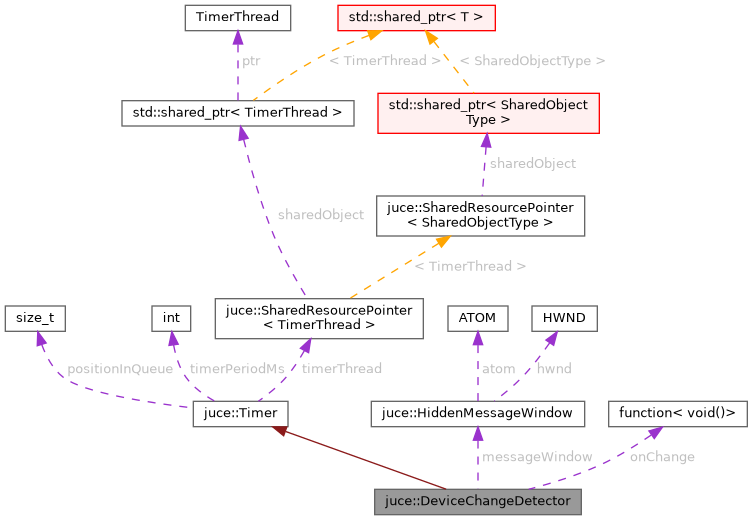
◆ messageWindow
◆ onChange
| std::function<void()> juce::DeviceChangeDetector::onChange |
|
private |
◆ positionInQueue
| size_t juce::Timer::positionInQueue = (size_t) -1 |
|
privateinherited |
◆ timerPeriodMs
| int juce::Timer::timerPeriodMs = 0 |
|
privateinherited |
◆ timerThread
The documentation for this class was generated from the following file:


 1.9.8
1.9.8