 |
JUCE v8.0.9
JUCE API
|

|
|
JUCE v8.0.9
JUCE API
|
|
A typeface represents a size-independent font. More...
#include <juce_Typeface.h>
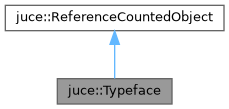
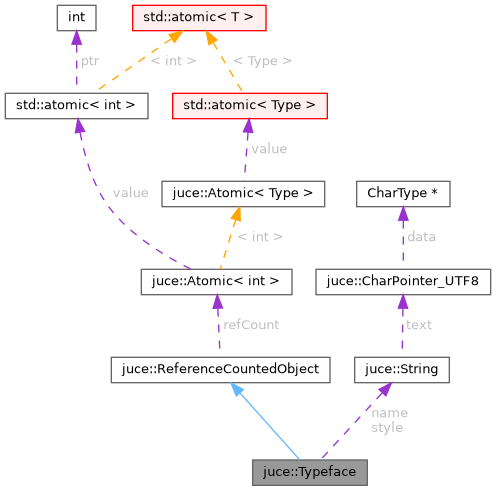
Public Types | |
| enum | ColourGlyphFormat { colourGlyphFormatBitmap = 1 << 0 , colourGlyphFormatSvg = 1 << 1 , colourGlyphFormatCOLRv0 = 1 << 2 , colourGlyphFormatCOLRv1 = 1 << 3 } |
| Kinds of colour glyph format that may be implemented by a particular typeface. More... | |
| using | Ptr = ReferenceCountedObjectPtr< Typeface > |
| A handy typedef for a pointer to a typeface. | |
Public Member Functions | |
| Typeface (const String &name, const String &newStyle) noexcept | |
| ~Typeface () override | |
| Destructor. | |
| void | applyVerticalHintingTransform (float fontHeight, Path &path) |
| Makes an attempt at performing a good overall distortion that will scale a font of the given size to align vertically with the pixel grid. | |
| virtual Typeface::Ptr | createSystemFallback (const String &text, const String &language) const =0 |
| Attempts to locate a font with a similar style that is capable of displaying the requested string. | |
| void | decReferenceCount () noexcept |
| Decreases the object's reference count. | |
| bool | decReferenceCountWithoutDeleting () noexcept |
| Decreases the object's reference count. | |
| int | getColourGlyphFormats () const |
| Returns an int with bits set indicating the format of colour glyphs contained in the typeface. | |
| EdgeTable * | getEdgeTableForGlyph (TypefaceMetricsKind, int glyphNumber, const AffineTransform &transform, float normalisedHeight) |
| Rectangle< float > | getGlyphBounds (TypefaceMetricsKind, int glyphNumber) const |
| Returns glyph bounds, normalised to a font height of 1.0. | |
| void | getGlyphPositions (TypefaceMetricsKind, const String &text, Array< int > &glyphs, Array< float > &xOffsets, float normalisedHeight=1.0f, float horizontalScale=1.0f) |
| std::vector< GlyphLayer > | getLayersForGlyph (TypefaceMetricsKind, int glyphNumber, const AffineTransform &) const |
| Returns the layers that should be painted in order to display this glyph. | |
| TypefaceMetrics | getMetrics (TypefaceMetricsKind) const |
| Returns information about the horizontal metrics of this font. | |
| const String & | getName () const noexcept |
| Returns the font family of the typeface. | |
| virtual Native | getNativeDetails () const =0 |
| std::optional< uint32_t > | getNominalGlyphForCodepoint (juce_wchar) const |
| Returns the glyph index corresponding to the provided codepoint, or nullopt if no such glyph is found. | |
| void | getOutlineForGlyph (TypefaceMetricsKind, int glyphNumber, Path &path) const |
| Returns the outline for a glyph. | |
| int | getReferenceCount () const noexcept |
| Returns the object's current reference count. | |
| float | getStringWidth (TypefaceMetricsKind, const String &text, float normalisedHeight=1.0f, float horizontalScale=1.0f) |
| const String & | getStyle () const noexcept |
| Returns the font style of the typeface. | |
| std::vector< FontFeatureTag > | getSupportedFeatures () const |
| Returns the OpenType features supported by this typeface. | |
| void | incReferenceCount () noexcept |
| Increments the object's reference count. | |
Static Public Member Functions | |
| static void | clearTypefaceCache () |
| Clears any fonts that are currently cached in memory. | |
| static Ptr | createSystemTypefaceFor (const Font &font) |
| Creates a new system typeface. | |
| static Ptr | createSystemTypefaceFor (const void *fontFileData, size_t fontFileDataSize) |
| Attempts to create a font from some raw font file data (e.g. | |
| static Ptr | createSystemTypefaceFor (Span< const std::byte >) |
| Attempts to create a font from some raw font file data (e.g. | |
| static Typeface::Ptr | findSystemTypeface () |
| Returns the system's default UI font. | |
| static void | scanFolderForFonts (const File &folder) |
| On some platforms, this allows a specific path to be scanned. | |
| static void | setTypefaceCacheSize (int numFontsToCache) |
| Changes the number of fonts that are cached in memory. | |
Protected Member Functions | |
| void | resetReferenceCount () noexcept |
| Resets the reference count to zero without deleting the object. | |
Private Attributes | |
| String | name |
| Atomic< int > | refCount { 0 } |
| String | style |
A typeface represents a size-independent font.
This base class is abstract, but calling createSystemTypefaceFor() will return a platform-specific subclass that can be used.
Normally you should never need to deal directly with Typeface objects - the Font class does everything you typically need for rendering text.
@tags{Graphics}
A handy typedef for a pointer to a typeface.
Kinds of colour glyph format that may be implemented by a particular typeface.
Most typefaces are monochromatic, and do not support any colour formats. Emoji fonts are likely to implement one or more colour font formats.
At this time, JUCE is able to render only bitmap and COLRv0 fonts. If you allow users to customise fonts, you may wish to hide or otherwise prevent users from selecting fonts that use unsupported colour formats.
|
override |
Destructor.
Makes an attempt at performing a good overall distortion that will scale a font of the given size to align vertically with the pixel grid.
The path should be an unscaled (i.e. normalised to height of 1.0) path for a glyph.
|
static |
Clears any fonts that are currently cached in memory.
|
pure virtual |
Attempts to locate a font with a similar style that is capable of displaying the requested string.
This uses system facilities, so will produce different results depending on the operating system and installed fonts. If it's important that your app uses the same fonts on all platforms, then you probably shouldn't use the results of this function.
Note that this accepts a string instead of a single codepoint because the OS may take combining marks and variation selectors into account when selecting an appropriate font. As an example, many fonts include a 'text'/'outline' version of the smiley face emoji. macOS may return Helvetica if the smiley emoji codepoint is passed on its own, but will return the emoji font if the emoji codepoint is followed by the variation-selector-16 codepoint.
To specify your own fallback fonts:
| text | the returned font will normally be capable of displaying the majority of codepoints in this string |
| language | BCP 47 language code of the text that includes this codepoint |
Creates a new system typeface.
|
static |
Attempts to create a font from some raw font file data (e.g.
a TTF or OTF file image). The system will take its own internal copy of the data, so you can free the block once this method has returned.
The typeface will remain registered with the system for as long as there is at least one owner of the returned Ptr. This allows typefaces registered with createSystemTypefaceFor to be created using just a typeface family name, e.g. in font fallback lists.
Attempts to create a font from some raw font file data (e.g.
a TTF or OTF file image). The system will take its own internal copy of the data.
The typeface will remain registered with the system for as long as there is at least one owner of the returned Ptr. This allows typefaces registered with createSystemTypefaceFor to be created using just a typeface family name, e.g. in font fallback lists.
|
inlinenoexceptinherited |
Decreases the object's reference count.
If the count gets to zero, the object will be deleted.
References jassert.
|
inlinenoexceptinherited |
Decreases the object's reference count.
If the count gets to zero, the object will not be deleted, but this method will return true, allowing the caller to take care of deletion.
References jassert.
|
static |
Returns the system's default UI font.
This will differ depending on the platform.
On Linux/fontconfig, this returns the typeface mapped to the name "system-ui", or nullptr if no such font exists.
On Windows, this queries SystemParametersInfo with the key SPI_GETNONCLIENTMETRICS, and returns the lfMessageFont that is returned, or nullptr if the font cannot be found.
On macOS and iOS, this returns the result of CTFontCreateUIFontForLanguage() for the kCTFontUIFontSystem typeface.
On Android 29+, this will use AFontMatcher to return the "system-ui" font. On earlier Android versions, this will attempt to return the Roboto font.
NOTE: The metrics of the system typeface may be significantly different from the metrics of the sans-serif font that JUCE would normally select to be the default font. This is especially evident on Windows: For Segoe UI (the Windows system typeface) the sum of ascender and descender is somewhat larger than the em-size of the font, but for Verdana (the JUCE default sans-serif font on Windows) the sum of ascender and descender is closer to the em-size. When the size of a font is set via FontOptions::withHeight() or Font::setHeight(), JUCE will scale fonts based on the sum of ascender and descender, so switching to Segoe UI might cause text to render at a much smaller size than with Verdana. You may get better results by setting font sizes in points using FontOptions::withFontHeight() and Font::setPointHeight(). When using points, Segoe UI still renders slightly smaller than Verdana, but the differences are less pronounced.
| int juce::Typeface::getColourGlyphFormats | ( | ) | const |
Returns an int with bits set indicating the format of colour glyphs contained in the typeface.
If the typeface has no colour glyphs, no bits will be set. Otherwise, one or more bits will be set depending on the format of the colour glyph information. You can use a bitwise-and operation with the members of the ColourGlyphFormat enum to determine whether a particular format is supported.
| EdgeTable * juce::Typeface::getEdgeTableForGlyph | ( | TypefaceMetricsKind | , |
| int | glyphNumber, | ||
| const AffineTransform & | transform, | ||
| float | normalisedHeight | ||
| ) |
Returns a new EdgeTable that contains the path for the given glyph, with the specified transform applied.
This is only capable of returning monochromatic glyphs. In fonts that contain multiple glyph styles with fallbacks (COLRv1, COLRv0, monochromatic), this will always return the monochromatic variant.
The height is specified in JUCE font-height units.
getLayersForGlyph() has better support for multilayer and bitmap glyphs, so it should be preferred in new code.
| Rectangle< float > juce::Typeface::getGlyphBounds | ( | TypefaceMetricsKind | , |
| int | glyphNumber | ||
| ) | const |
Returns glyph bounds, normalised to a font height of 1.0.
| void juce::Typeface::getGlyphPositions | ( | TypefaceMetricsKind | , |
| const String & | text, | ||
| Array< int > & | glyphs, | ||
| Array< float > & | xOffsets, | ||
| float | normalisedHeight = 1.0f, |
||
| float | horizontalScale = 1.0f |
||
| ) |
Converts a line of text into its glyph numbers and their positions. You should never need to call this!
| std::vector< GlyphLayer > juce::Typeface::getLayersForGlyph | ( | TypefaceMetricsKind | , |
| int | glyphNumber, | ||
| const AffineTransform & | |||
| ) | const |
Returns the layers that should be painted in order to display this glyph.
Layers should be painted in the same order as they are returned, i.e. layer[0], layer[1] etc.
This should generally be preferred to getEdgeTableForGlyph, as it is more flexible. Currently, this only supports COLRv0 and bitmap fonts (no SVG or COLRv1). Support for SVG and COLRv1 may be added in the future, depending on demand. However, this would require significant additions to JUCE's rendering code, so it has been omitted for now.
| TypefaceMetrics juce::Typeface::getMetrics | ( | TypefaceMetricsKind | ) | const |
Returns information about the horizontal metrics of this font.
|
inlinenoexcept |
Returns the font family of the typeface.
|
pure virtual |
At the moment, this is a way to get at the hb_font_t that backs this typeface. The typeface's hb_font_t has a size of 1 pt (i.e. 1 pt per em). This is only for internal use!
| std::optional< uint32_t > juce::Typeface::getNominalGlyphForCodepoint | ( | juce_wchar | ) | const |
Returns the glyph index corresponding to the provided codepoint, or nullopt if no such glyph is found.
| void juce::Typeface::getOutlineForGlyph | ( | TypefaceMetricsKind | , |
| int | glyphNumber, | ||
| Path & | path | ||
| ) | const |
Returns the outline for a glyph.
The path returned will be normalised to a font height of 1.0.
|
inlinenoexceptinherited |
Returns the object's current reference count.
| float juce::Typeface::getStringWidth | ( | TypefaceMetricsKind | , |
| const String & | text, | ||
| float | normalisedHeight = 1.0f, |
||
| float | horizontalScale = 1.0f |
||
| ) |
Measures the width of a line of text. You should never need to call this!
|
inlinenoexcept |
Returns the font style of the typeface.
| std::vector< FontFeatureTag > juce::Typeface::getSupportedFeatures | ( | ) | const |
Returns the OpenType features supported by this typeface.
This method returns a list of all OpenType font features (such as ligatures, small caps, stylistic alternates, etc.) that are available in the current typeface.
|
inlinenoexceptinherited |
Increments the object's reference count.
This is done automatically by the smart pointer, but is public just in case it's needed for nefarious purposes.
|
inlineprotectednoexceptinherited |
Resets the reference count to zero without deleting the object.
You should probably never need to use this!
|
static |
On some platforms, this allows a specific path to be scanned.
On macOS you can load .ttf and .otf files, otherwise this is only available when using FreeType.
|
static |
Changes the number of fonts that are cached in memory.
|
private |
|
privateinherited |
|
private |
 1.9.8
1.9.8