 |
JUCE v8.0.9
JUCE API
|

|
|
JUCE v8.0.9
JUCE API
|
|
Helper class to update several animators at once, without owning or otherwise extending the lifetimes of those animators. More...
#include <juce_AnimatorUpdater.h>
Classes | |
| struct | Entry |
Public Member Functions | |
| void | addAnimator (const Animator &animator) |
| Registers an Animator with the updater. | |
| void | addAnimator (const Animator &animator, std::function< void()> onComplete) |
| Registers an Animator with the updater and specifies a callback to be called upon the completion of the Animator. | |
| void | removeAnimator (const Animator &animator) |
| Removes an Animator. | |
| void | update () |
| Calls Animator::update() for all registered Animators that are still alive. | |
| void | update (double timestampMs) |
| Calls Animator::update() for all registered Animators that are still alive. | |
Private Attributes | |
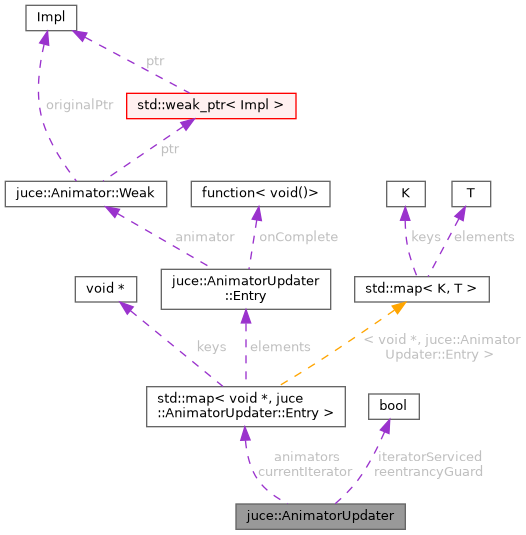
| std::map< void *, Entry > | animators |
| std::map< void *, Entry >::iterator | currentIterator |
| bool | iteratorServiced = false |
| bool | reentrancyGuard = false |
Helper class to update several animators at once, without owning or otherwise extending the lifetimes of those animators.
The intended use case is to register Animators with an updater as opposed to separately calling Animator::update() on each of them. Calling update() then will update all registered Animators. In case an Animator's underlying implementation is deleted (all Animator objects that were strongly referencing it were deleted) it is automatically removed by the AnimatorUpdater.
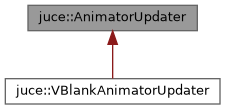
If you want to update all your Animators in sync with the display refresh you will probably want to use the VBlankAnimatorUpdater.
The order in which Animator::update() functions are called for registered Animators is not specified, as Animators should be implemented in a way where it doesn't matter.
@tags{Animations}
| void juce::AnimatorUpdater::addAnimator | ( | const Animator & | animator | ) |
Registers an Animator with the updater.
| void juce::AnimatorUpdater::addAnimator | ( | const Animator & | animator, |
| std::function< void()> | onComplete | ||
| ) |
| void juce::AnimatorUpdater::update | ( | ) |
Calls Animator::update() for all registered Animators that are still alive.
References to deleted Animators are removed.
Uses Time::getMillisecondCounterHiRes() to calculate the necessary timestamp. Consider using a VBlankAnimatorUpdater instead for using timestamps that are synchronised across all VBlankAnimatorUpdater instances.
| void juce::AnimatorUpdater::update | ( | double | timestampMs | ) |
Calls Animator::update() for all registered Animators that are still alive.
References to deleted Animators are removed.
The supplied timestamp should be monotonically increasing for correct behaviour. Ideally this should be a timestamp supplied by a VBlankAttachment. Consider using the VBlankAnimatorUpdater class, which takes care of supplying the right timestamp.
|
private |
|
private |
|
private |
|
private |
 1.9.8
1.9.8